# BPMN-AI Modeling Fundamentals
## 1. The Limits of Traditional Automation
Business Process Management systems have delivered enormous value to enterprise systems by structuring predictable work. _When an order exceeds a threshold, route to approval. When a payment is due, trigger a reminder. When a form is submitted, validate the fields._ These deterministic patterns — _if this, then that_ — form the backbone of enterprise automation.
But organizations operate in an increasingly complex world of documents, data, and decisions. Contracts arrive in different structures. Customer inquiries require interpretation. Invoices are available in various languages and formats. In this area, traditional BPM offers only two options: human processing or brittle rule-based parsing that breaks when formats vary.
The fundamental limitation is architectural. Traditional systems operate on explicit data—values in defined fields, keywords in specified locations, metadata attached by upstream processes. They cannot operate on meaning because they have no capacity for comprehension.
## 2. The AI Integration Problem
Large Language Models (LLMs) have changed what machines can do. They can read a document and identify its type — not by keyword matching but by understanding its purpose. They can extract data from unstructured text — not by parsing fixed layouts but by comprehending content. They can evaluate nuanced conditions — not through boolean logic but through semantic reasoning.
These capabilities are transformative. But capability alone does not create enterprise value. The challenge is integration — and current approaches fall short.
Most AI integration follows a familiar pattern: the workflow reaches a point where intelligence is needed, calls an external API, receives a response, and continues. The AI operates as a service alongside the process, not as part of it. This creates three critical problems:
- **Opacity** The AI operation is invisible in the process model. Stakeholders see that something happens; they cannot see what. The process diagram shows a service call, not the logic being applied.
- **Inflexibility** Changing AI behavior requires developer involvement. The prompt lives in code, not in the process definition. Process owners who understand the business requirement cannot directly modify how AI applies to their processes.
- **Governance gaps** AI decisions occur outside the workflow's audit framework. The process log shows inputs and outputs; it does not capture the reasoning in between. Compliance and audit functions face a blind spot precisely where judgment is being exercised.
These problems are not incidental — they are inherent to treating AI as an external service. As long as intelligence lives outside the process model, it remains outside process governance.
## 3. A New Approach: Model-Driven AI Process Automation
Dynamixs.AI addresses these problems through a fundamental architectural choice: AI capabilities are not services called from workflows — they are workflow elements themselves.
A document categorization is modeled in the BPMN diagram just as a user task would be. A natural language decision condition appears at a gateway just as a boolean expression would. A knowledge retrieval operation is visible in the process flow just as a database query would be. The process model does not invoke AI; it incorporates AI as a first-class modeling construct.
This is not a difference in degree but in kind. It creates a new category of enterprise software where:
- Process designers model AI behavior through the same tools they use for all process design — no developer handoff required
- AI operations are visible in process diagrams, understood by business stakeholders, documented in process artifacts
- AI configuration is auditable — prompts, decision logic, and knowledge queries are versioned process elements, not hidden code
- Governance frameworks apply uniformly to human tasks, system integrations, and AI operations alike
The intelligence is woven into the process definition itself. When a process designer opens the model, they see not just what humans do and what systems do, but what AI does — and they can configure all three through a unified approach.
## 4. Six Foundational Methodologies
This architectural foundation enables six distinct capabilities that together transform document-centric business processes:
1. Categorization — Intelligent classification and routing based on semantic understanding of document content
2. Summarization — Context-aware abstraction tailored to document type and process requirements
3. Extraction — Transformation of unstructured content into normalized, structured data
4. Natural Language Decisions — Business rules expressed in human language, evaluated against full process context
5. Assistant Systems — Continuous AI support with conversational memory spanning the workflow lifecycle
6. Knowledge Integration — Organizational learning through retrieval-augmented generation across workflow instances
These are not independent features but interconnected methodologies. Categorization determines which summarization strategy applies. Summarization provides context for extraction. Extracted data informs natural language decisions. The assistant maintains continuity across all interactions. And knowledge integration ensures that every completed workflow makes the organization more intelligent.
The following sections examine each methodology: the business problem it addresses, the approach Dynamixs.AI takes, and the strategic value it delivers.
### 4.1. Semantic Categorization
When documents enter an organization, they must be classified before any process can begin. Traditional approaches rely on metadata, keyword matching, or trained classifiers — all operating on hard coded business logic rather than meaning. They fail when data arrive through unexpected channels, use unexpected terminology, or vary from expected formats.
Semantic categorization works differently: the system reads the document and understands what it is. Not searching for keywords, but comprehending structure, purpose, and content. The output is structured classification data — document type, customer identity, language, urgency — that determines which workflow handles the document and how.
```xml
Invoice
214 TechBridge Tokyo
JP
0.75
```
In Dynamixs.AI, categorization is modeled as a BPMN element within the process definition. The classification logic is configured by the process designer, visible in the process diagram, versioned with the process definition.
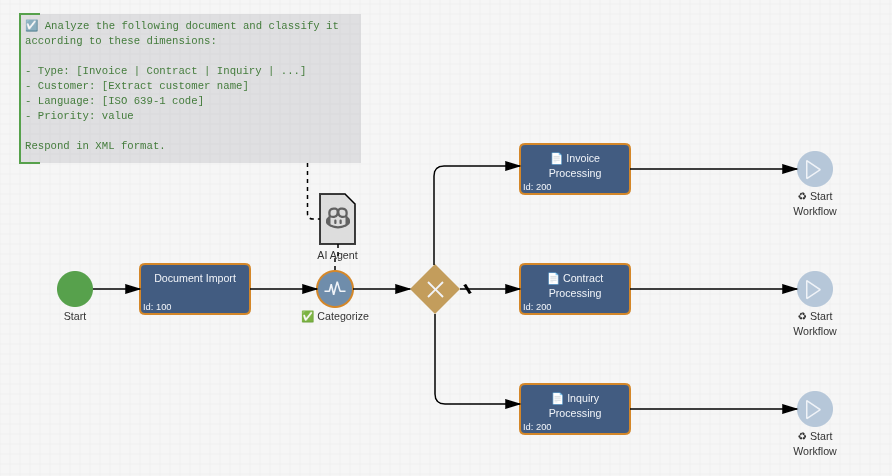 When requirements change, the process owner adjusts the categorization directly—no development cycle required.
Documents route to appropriate processes within seconds rather than waiting in human triage queues. Classification scales elastically with volume. And the logic that previously existed only in experienced employees' heads becomes explicit, auditable organizational infrastructure.
**Key Benefits:**
- Eliminates manual document triage
- Handles format variations automatically
- Provides consistent classification across document types
- Classification criteria can be modified without code changes
### 4.2. Contextual Summarization
Knowledge workers spend significant time reading documents to extract relevant information. A five-page contract, a detailed incident report, a lengthy customer correspondence—each must be read in full to identify what matters for the task at hand. The document management system stores and retrieves faithfully, but delivers documents as-is, leaving comprehension entirely to the human reader.
Contextual summarization generates process-specific abstracts tailored to document type and task requirements. An invoice summary emphasizes amounts, dates, and payment terms. A contract summary highlights obligations, duration, and risk factors. The same document produces different summaries for different process contexts — each optimized for the decisions that follow.
In Dynamixs.AI, summarization is modeled as a BPMN element that follows categorization. The summarization strategy — what to emphasize, what level of detail, what language—is configured per document type and process stage. The summary is generated before the human task begins, not on demand.
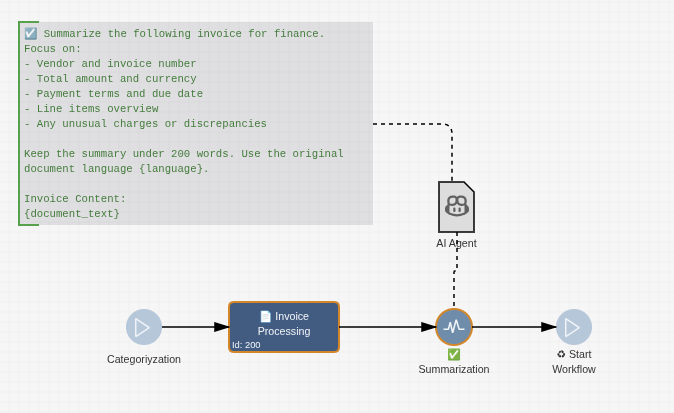 Workers receive focused abstracts rather than raw documents. Review time drops dramatically. Attention concentrates on what matters. And summarization logic adapts to process requirements through configuration, not code.
**Key Benefits:**
- Reduces document review time by 60-80%
- Ensures consistent focus on process-relevant information
- Summaries adapt to document type automatically
- Supports multilingual documents with language-appropriate output
### 4.3. Structured Extraction
Enterprise systems run on structured data—fields with defined formats, values within expected ranges, dates in standard notation. Yet information arrives unstructured: invoices as PDFs, contracts as Word documents, correspondence as free text. The bridge between these worlds is largely built by human hands, typing data from documents into system fields.
Structured extraction transforms unstructured content into normalized data. The system identifies relevant information—invoice numbers, dates, amounts, parties, terms—and outputs it in structured format. Crucially, extraction includes normalization: dates convert to ISO format regardless of source notation, amounts standardize regardless of decimal conventions, currencies map to standard codes. The document language detected during categorization guides these transformations automatically.
In Dynamixs.AI, extraction is modeled as a BPMN element that operates on document content or summaries. The extraction schema—which fields to capture, what normalizations to apply—is defined in the process model. Each extracted value carries a confidence indicator, enabling automatic processing for high-confidence extractions and human verification where needed.
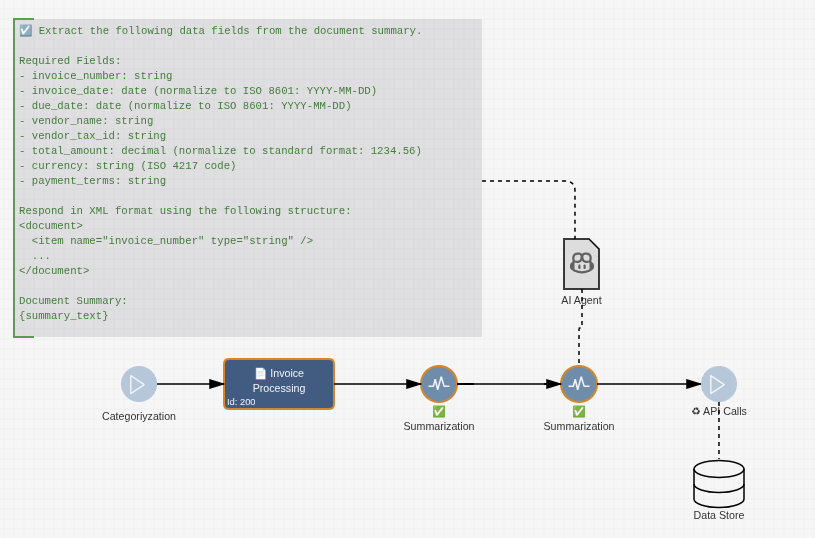 Manual data entry reduces by 80-90% for well-defined schemas. Format variations no longer break processing. And extracted data flows directly into forms, validations, and downstream systems.
**Output Example:**
```xml
- INV-2024-0847
- 2025-03-15
- 2025-04-14
- TechBridge Tokyo
- 4523.80
- USD
- 30 days net
```
**Key Benefits:**
- Eliminates manual data entry for 80-90% of standard documents
- Confidence scoring enables targeted human review
- Locale-aware normalization ensures data consistency
- XML output integrates directly with form systems and downstream processes
### 4.4. Natural Language Decisions
Business processes require routing decisions. Traditional BPMN gateways evaluate boolean expressions against process variables: _amount > 10000_ or _customer.status == 'premium'_. This works for simple thresholds but fails for nuanced business rules. _"Does this contract contain unusual liability provisions?"_ or _"Is this shipment subject to export controls?"_ resist expression as boolean formulas. The result is a gap between business intent and system implementation—rules that seem clear in discussion become ambiguous in code.
Natural language decisions allow gateway conditions to be expressed as business stakeholders would state them. The system evaluates the condition against available context — extracted data, document summaries, process variables—and returns a clear routing outcome. When confident determination is not possible, the workflow routes to human judgment rather than applying arbitrary defaults.
In Dynamixs.AI, natural language conditions are configured directly at BPMN gateways. The business rule is visible in the process diagram, readable by non-technical stakeholders, adjustable without developer involvement. Every decision logs the condition evaluated, the context considered, and the outcome determined.
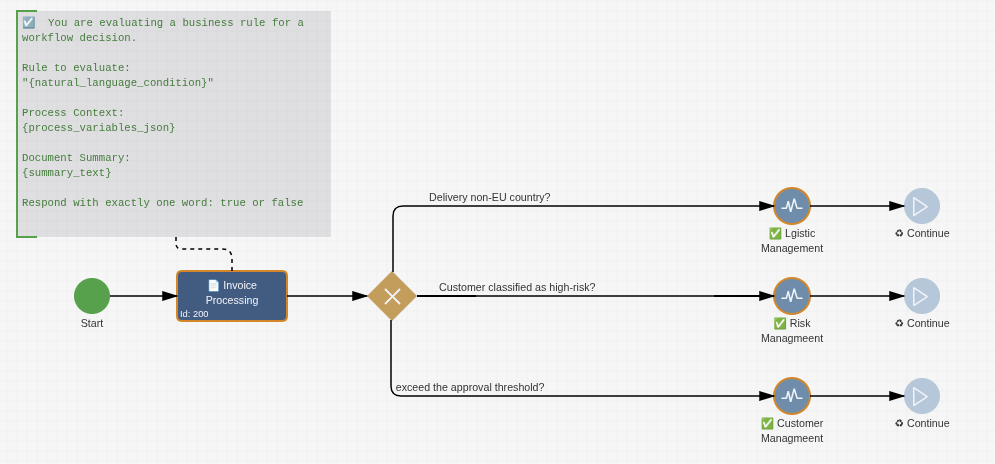 Complex contextual decisions become possible without programming. Business rules remain aligned with business intent. And decision logic is transparent and auditable.
**Example Conditions:**
- "Is this a delivery to a non-EU country?"
- "Does the contract value exceed the approval threshold for this department?"
- "Is the customer classified as high-risk?"
- "Does this request require legal review based on the contract terms?"
- "Is this a recurring customer with an existing framework agreement?"
**Key Benefits:**
- Business rules remain readable and maintainable
- Non-technical stakeholders can understand and modify conditions
- Complex contextual decisions become possible without programming
- Full audit trail of decisions and reasoning
### 4.5 Assistant Systems
The previous methodologies — _categorization, summarization, extraction, decisions_ — operate at discrete points in a workflow. Each interaction is stateless. This mirrors how most organizations have integrated AI capabilities: isolated calls to language models, each starting fresh without memory of prior interactions.
But knowledge work is not a series of independent transactions. It is iterative, contextual, and cumulative. Questions arise during processing. Earlier insights become relevant to later decisions. A worker reviewing extracted data might wonder why a particular value was proposed. A manager approving an exception might need to understand the full history of how the case developed. A specialist encountering an unusual situation might benefit from exploring implications with an informed partner.
Traditional support systems — chatbots, help desks, knowledge bases — cannot help here. They operate outside the workflow context. The worker must leave their task, explain their situation from scratch, receive generic assistance, and translate it back to their specific case. The support system knows nothing of the document being processed, the classification that was made, the data that was extracted, or the decisions that are pending.
**Persistent Context Across the Process Lifecycle**
Dynamixs.AI solve this problem by maintaining conversational continuity across the entire workflow lifecycle. The key insight is that each AI interaction within the workflow is not merely an isolated operation but a contribution to an evolving understanding.
When a document is categorized, that analysis becomes part of the shared context. When a summary is generated, the assistant already knows what type of document it is dealing with. When data is extracted, the context includes both the categorization and the summarization. When a decision is evaluated, the full history of prior analysis informs the judgment.
This context does not reset between steps. It accumulates during the processing live-cycle. By the time a human worker engages with the process, the assistant understands everything that has occurred: what the document contains, how it was classified, why certain data was extracted, what decisions were made and on what basis.
For long-running processes — a construction project spanning months, a contract negotiation over weeks, a compliance review requiring multiple approvals — this continuity is transformative. A question asked in month three can reference context established in month one. The assistant's understanding grows as the process progresses, mirroring how a knowledgeable colleague would accumulate familiarity with a case over time.
**Human-AI Collaboration Within Structured Workflow**
Workers interact with the assistant at any point during their tasks. They can ask why a particular extraction was proposed and receive an explanation grounded in the document content. They can request alternative interpretations of ambiguous passages. They can explore what-if scenarios for pending decisions. They can verify their understanding before committing to an action.
This is not a chatbot bolted onto the workflow. It is an informed participant in the process, constrained by the same governance framework, contributing to the same audit trail, operating within the same process boundaries.
**Modeled as BPMN Elements**
In Dynamixs.AI, assistant interactions is part of the model reading and writing to the shared conversation context. The process designer defines where assistant interaction is available, what context is included, and how conversations are preserved.
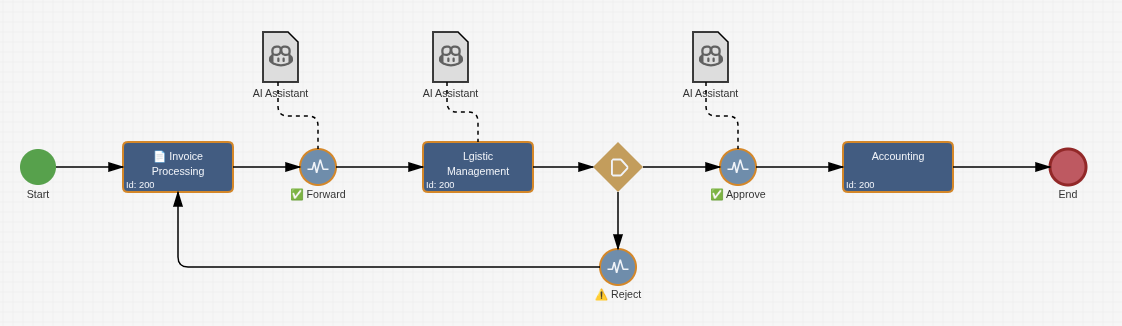 The accumulated dialogue becomes part of the workflow record — visible, auditable, and available for review.
```json
{
"workflow_id": "WF-2024-08472",
"messages": [
{
"role": "system",
"content": "You are an assistant helping process incoming invoices...",
"timestamp": "2024-03-15T09:00:00Z",
"bpmn_element": "SystemPromptTask"
},
{
"role": "user",
"content": "Categorize the following document: [document content]",
"timestamp": "2024-03-15T09:00:01Z",
"bpmn_element": "CategorizationTask"
},
{
"role": "assistant",
"content": "{\"document_type\": \"Invoice\", ...}",
"timestamp": "2024-03-15T09:00:03Z",
"bpmn_element": "CategorizationTask"
},
{
"role": "user",
"content": "Based on the categorization, summarize this invoice...",
"timestamp": "2024-03-15T09:00:04Z",
"bpmn_element": "SummarizationTask"
}
]
}
```
The strategic impact extends beyond individual productivity. New employees can engage effectively with complex cases because the assistant provides process-aware guidance. Quality improves because workers can verify interpretations before acting. Knowledge accumulates within the process record rather than dissipating when the task is complete.
**Key Benefits:**
- AI maintains context across entire process lifecycle
- Earlier insights inform later processing steps
- Human-AI collaboration within structured workflow
- Complete conversation audit trail for compliance
### 4.6 Knowledge Integration - Retrieval-Augmented Generation (RAG)
Organizations execute thousands of workflows. Each generates information: what happened, what was decided, what worked, what failed. This information has potential value far beyond the individual process instance. Lessons learned on Project A could prevent mistakes on Project B. Customer preferences discovered in one interaction could improve service in future interactions. The exception handling developed for one case could apply to similar cases months later.
Yet this knowledge typically remains locked within completed process instances. The workflow system records everything — fully traceable, completely documented—but does not make that knowledge accessible to future work. Finding relevant precedents requires knowing they exist and searching explicitly. Each new workflow begins fresh, unable to benefit from the thousands that came before.
This is organizational amnesia at the operational level. Strategic insights might surface in quarterly reviews and lessons-learned sessions. But day-to-day knowledge — specific customer preferences, practical warnings, discovered patterns—dissipates as processes complete and employees move to new tasks.
#### 4.6.1 Bidirectional Knowledge Flow
Dynamixs.AI Knowledge Integration addresses this problem through retrieval-augmented generation (RAG) operating in two directions: workflows contribute knowledge on certain points in the processing life-cycle and workflows receive knowledge when needed or a new workflow begins.
- **Knowledge Contribution** When a workflow completes, the system analyzes what occurred and extracts durable insights. This is not a mechanical summary but a synthesis focused on future utility: What should be remembered? What warnings apply? What preferences emerged? What patterns were discovered? The insight is stored alongside identifying metadata—customer, project, product, process type—enabling semantic retrieval when relevant contexts arise.
- **Knowledge Retrieval** When a new workflow begins, the system queries the knowledge base for relevant precedents. Related insights are synthesized into a contextual briefing: prior interactions with this customer, warnings from similar cases, preferences that emerged in past dealings, patterns that proved relevant. This briefing appears before the worker begins their task—proactive knowledge delivery rather than passive search.
The critical difference from traditional knowledge management is the direction of initiative. Conventional systems wait to be asked. A worker who suspects relevant precedents exist can search for them — if they know what to search for, if they have time to search, if they remember to search at all. In practice, this means most relevant knowledge goes undiscovered. The search never happens.
Knowledge Integration inverts this pattern. The system identifies what might be relevant and volunteers it. A new workflow involving Customer X automatically surfaces the history with Customer X. A case resembling past problematic patterns automatically raises the warning flags. The worker does not need to know what to look for; the system brings relevant context forward.
This is how experienced employees naturally operate—they remember relevant history and apply it to new situations. Knowledge Integration makes this organizational memory systematic rather than individual, persistent rather than dependent on personnel continuity.
#### 4.6.2 Compounding Organizational Intelligence
Every completed workflow makes the organization marginally more intelligent. A single insight may seem modest. But across thousands of workflows, knowledge compounds. Patterns emerge. Customer relationships deepen. Institutional expertise accumulates in infrastructure rather than individual heads.
New employees benefit immediately from organizational history. Experienced employees are reminded of relevant precedents they may have forgotten. Transitions between personnel no longer mean loss of operational knowledge. The organization learns from its own experience, automatically and continuously.
In Dynamixs.AI, both knowledge contribution and knowledge retrieval are modeled as BPMN elements within process definitions. The process designer configures what insights to extract upon completion, what queries to execute upon initiation, and how knowledge flows between process types.
This makes knowledge strategy visible and governable. Which processes contribute to which knowledge domains? What contextual briefings do workers receive? How is insight quality maintained over time? These questions have explicit answers in the process model, not implicit answers in hidden system behavior.
The strategic impact is cumulative. Organizations that implement Knowledge Integration do not merely automate processes—they build learning systems. Each workflow execution becomes a contribution to organizational intelligence that persists beyond the individual case, the individual employee, and the individual moment.
**Store Prompt Structure:**
```
Analyze this completed workflow and extract key insights for future reference.
Focus on:
- Specific outcomes and decisions made
- Unusual circumstances or exceptions
- Customer preferences or requirements discovered
- Warnings for similar future cases
- Relevant names, amounts, and dates
Respond with 2-3 sentences. Be specific, not generic.
Workflow Summary:
{workflow_summary}
```
**Retrieve Prompt Structure:**
```
Based on the following historical insights related to this customer/project/product,
generate a briefing for the worker starting this new workflow.
Current Workflow Context:
- Customer: {customer_name}
- Document Type: {document_type}
- Subject: {subject}
Related Historical Insights:
{rag_results}
Generate a brief (3-5 sentences) contextual briefing highlighting:
- Relevant past interactions
- Known preferences or issues
- Warnings or recommendations
```
**Key Benefits:**
- Organizational knowledge accumulates automatically
- New workflows benefit from historical context
- Proactive knowledge delivery (system volunteers information)
- Searchable knowledge base grows with every completed workflow
# 5. Conclusion
The six methodologies presented in this paper share a common architectural principle: AI capabilities are implemented as native BPMN 2.0 elements, configured through process modeling rather than software development.
This design choice has significant implications. Prompt definitions, extraction schemas, decision conditions, and knowledge queries are process artifacts—versioned, documented, and modifiable through standard BPM tooling. When business requirements change, process designers adjust AI behavior directly. The iteration cycle between requirement and implementation shortens from weeks to minutes.
The BPMN 2.0 foundation also ensures that AI operations participate in established governance frameworks. Every AI interaction is logged as a workflow event. Audit trails capture inputs, outputs, and configuration state. The same compliance mechanisms that govern human tasks and system integrations apply to AI elements without architectural exception.
The compositional nature of BPMN modeling extends to AI capabilities. Organizations combine methodologies as their processes require—categorization alone for simple routing, full integration of all six methodologies for complex knowledge work. Process complexity scales through model composition, not custom development.
Technically, the platform maintains model independence through standardized adapter interfaces. Language models can be exchanged—cloud providers, on-premise deployments, open-source alternatives—without modifying process definitions. Organizations retain control over their AI infrastructure decisions while protecting their investment in process design.
This architecture—AI as modelable, composable, governable process elements—represents a distinct approach to intelligent process automation. The methodologies described in this paper provide the foundation; BPMN 2.0 provides the integration framework that makes them accessible to process designers rather than AI specialists.